 |
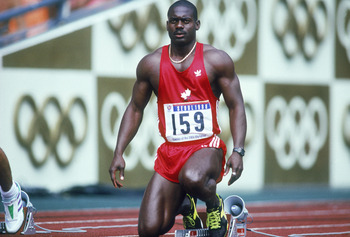
| Canadian sprinter Ben Johnson. |
A politician is usually the first
image that comes to mind when one thinks about a person with “dirty hands”. Someone has “dirty hands” when they have to
do something morally incorrect in order to accomplish something good. In Walzer’s Political
Action: The Problem of Dirty Hands he claims, “…that politicians are a
good deal worse, morally worse, than the rest of us….” I think Walzer’s quote
is harsh and unfair to single out just politicians. I believe professional athletes that cheat in
order to accomplish a goal for themselves are just as or even more
reprehensible.
It seems that we are always hearing
in the media how a politician has misused the power of his office to engage in
some wrongdoing. The media will claim
that politicians are morally corrupt and appalling because they abused their
authoritative power. But why aren’t
professional athletes held to the same scrutiny as politicians? Athletes represent their fans similar to the
way politicians represent their constituents.
Also, fans are able to indirectly influence who is on their team by
attending games and buying team related gear.
The money that fans spend goes to their respective team and owners are
able to acquire new players based on how much fans pay.
Unethical behavior is present in
all types of sports: baseball, football, hockey, basketball, and so on. Well-known instances of despicable conduct
among athletics include Joe Niekro’s scuffing the baseball, Tonya Harding
attacking Nancy Kerrigan, and many more. A problem we have heard a lot about in the
news lately is the use of performance-enhancing drugs, often referred to as
steroids. When athletes decide to use
steroids they are committing a moral crime and they have “dirty hands” because
they’re doing something morally incorrect in order to achieve something beneficial
for themselves and/or their team. Many
of these athletes believe steroids are essential to help them compete at a high
performance level and to contribute to their teams’ success.
Roger Clemens is
one of the more famous athletes to use steroids. Roger Clemens, for the people that do not
know, was a Major League Baseball pitcher and he helped his teams win two World
Series. Clemens played for twenty-four
seasons and for four different teams. He was able to prolong his career and compete
at a high-level because he used steroids.
Clemens had “dirty hands” because he cheated, which is morally wrong, in
order to enhance his skills and lead his teams to championships.
Another example of a high profile
athlete that got busted using steroids is sprinter Ben Johnson. Johnson was an Olympic sprinter from Canada
and he set the world record in the 100m.
He won the gold medal on September 24th at the 1988 Olympics in the 100m
event with a time of 9.79*. His
achievement was short-lived, however, because three days later the
International Olympic Committee found steroids in his urine and stripped him
of his medal.
But why I am frustrated with
athletes that use steroids? It angers me
that Walzer labels politicians as more morally corrupt than the rest of us when
athletes are just as dirty. It
frustrates me that politicians are always classified as the bad guys. Politicians, in general, do more good than
bad. I am tired of hearing that
politicians have no moral codes or ethics when professional athletes, whom many
individuals idolize, are even more morally inept.
Do you think politicians deserve to
be the symbol of “dirty hands”? What
other groups have “dirty
hands” and why are they not held to the same scrutiny
as politicians?
Below is a short clip of Alex Rodriguez, third baseman for the New York Yankees, explaining why he used steroids.

First, I think that there is a fundamental distinction between athletes and politicians. Politicians, when they do immoral / amoral acts, they do so on the behalf of the public. The public has in some form given them a vote of confidence, and when that trust is betrayed, people are mad not only for the action that occurred, but also that they were duped in a sense. Athletes on the other hand, don't play with our (the public's)money. They may play for money or with one extremely rich person's money, but not the public's money.
ReplyDeleteThis fundamentally differentiates the actions of athletes and politicians. Politicians are tasked with answering to the public, while athletes are not. Athletes are more or less playing a game, and if in their eyes, they view "winning" that game as making more money, performance enhancing drug use may be beneficial.
Frankly, I believe our idolization of athletes is out of control. When Tyrann Mathieu gets caught with some weed, it is a national news story, but nobody else really cares when any other 20-something is caught with pot. Why should athletes be role models when they have careers that almost nobody else will ever have?
I also think you should be quite careful when candidly saying Roger Clemens used steroids, especially without citing a source. In fact, he was found not guilty on SIX charges of lying to Congress during their 2008 investigation (1). While it is certainly likely that he did in fact use PEDs, you ought to use caution when making claims which haven't been proven true.
(1) http://content.usatoday.com/communities/dailypitch/post/2012/06/roger-clemens-verdict/1?csp=breakingnews#.UJGwNbTfJSU
You bring up an interesting point in this blog. However, I feel that I am on the same point of view of Chris. Politicians don't just represent the sport-loving public, rather, they represent the public as a whole. It is their duty to make sure their constituents are receiving what they need for a well-lived life. On the other hand, I like to think that athletes represent two categories of people. The first is the sport-loving crowd and the second is themselves. When, let's just say Prince Fielder, steps up to bat, I believe he is trying to get a hit for himself (to boost his BA) and for the crowd watching him (to boost the energy of the fans). However, he isn't going to want to get a hit for the people that never watch baseball or have no interest in sports at all. When an athlete is found cheating the game, the fans do feel a sense of betrayal. These athletes do have "dirty hands" because they know from the beginning that cheating is immorally wrong. However, when a politician has "dirty hands", the caliber is much different.
ReplyDeleteWelzer did put some much emphasis on the politicians because they have a bigger task at hand. I guarantee that a business person in New York that doesn't have any interest in sports hasn't heard about Melky Cabrera's suspension for PED's (http://www.wjla.com/articles/2012/08/melky-cabrera-suspended-50-games-for-steroid-policy-violation-78872.html). However, I guarantee that the majority of America has heard about Nixon's Watergate Scandal and his "dirty hands". The difference is simple. Politicians are trusted more heavily than athletes ever will be. Our ways of life depend on the politicians. Politicians understand this task and when they achieve it with "dirty hands", a larger sense of betrayal is felt by the public.
However, Welzer does form the stereotype that all politicians are morally corrupt. I think that ALL politicians are not bad, however, a good number of them are in it for themselves. Overall, athletes and politicians are both able to have "dirty hands". However, when politicians have "dirty hands", it will always be a bigger deal and have a bigger impact on the public.
I understand what you both, Chris and Jeffrey, are saying about politics but I feel that I am in more agreement with Mark on this one. Yes, politicians are often seen as morally corrupt, but I feel like you guys are not quite getting at situations when they exhibit dirty hands. You guys both talked about how people get upset with politicians when they let down the public as a whole, or they fail to represent the public or their constituencies as a whole. But if that is the case, then you aren't speaking of a case of dirty hands. Dirty hands is when someone makes a decision that is morally wrong, but makes it because it will be beneficial to the majority of the people. So if the majority of the people feel they have been let down or mis-reprsented, as you both said, then that isn't a case of dirty hands. That is just simply a politician making a bad decision in his job. If it were a case of dirty hands, I believe those people would have had to have been benefited by whatever the politician did. They wouldn't be upset at his decision or feel mis-represented necessarily, but they would just be judging on their politicians morals. I'm not sure if this is what you meant, I might have misunderstood what you were both trying to say. But I just think it is important to keep that in mind. And I get the point Mark is making about athletes and dirty hands, but I think the reason people don't ever give too much thought to the issue of dirty hands with athletes is basically because politicians run our country and make decisions for our futures, whereas athletes are simply playing a game for our entertainment. So although, the moral wrongdoings they may commit are just as immoral as those of politicians, people don't worry about outcomes of games as much as they do about the future of America.
ReplyDelete