 Depending on your political beliefs, President Obama may or may not be doing a good job of managing America. To the untrained eye, he seems to be making changes here and there that please some people and upset others. However, if you scrutinize his decisions and his platform as a whole, you may be surprised to find that Obama is borrowing pages from Marx's Manifesto.
His initial victory in 2008 brought him immense power, which he has used to redistribute wealth and bring corporations under state control. Does this sound familiar yet? If not, don't worry… there's more:
- Obama forced major banks to take federal bailout money even when they did not need it. As part of his stimulus plan, he mandated that these banks pass 'stress tests' before being relieved of state control.
- Regardless of what he says, Obama wants to do away with tax cuts while raising taxes.
- Obama wants to increase the inheritance tax. Plank #3 anybody?
- Obama is against companies moving their operations overseas in order to participate in the global economy. If you look at it from a different perspective, one could say that he would prefer if the State had control in this situation, similar to Plank #7.
I think it's fair to say that most people don't notice the similarities between Obama's principles and Marx's. How did he do it, then? The answer is in the media. By using mass media to distribute his party's propaganda, he gradually made capitalists into the public enemy. He was able to convince enough of those who were victimized by America's financial crisis.
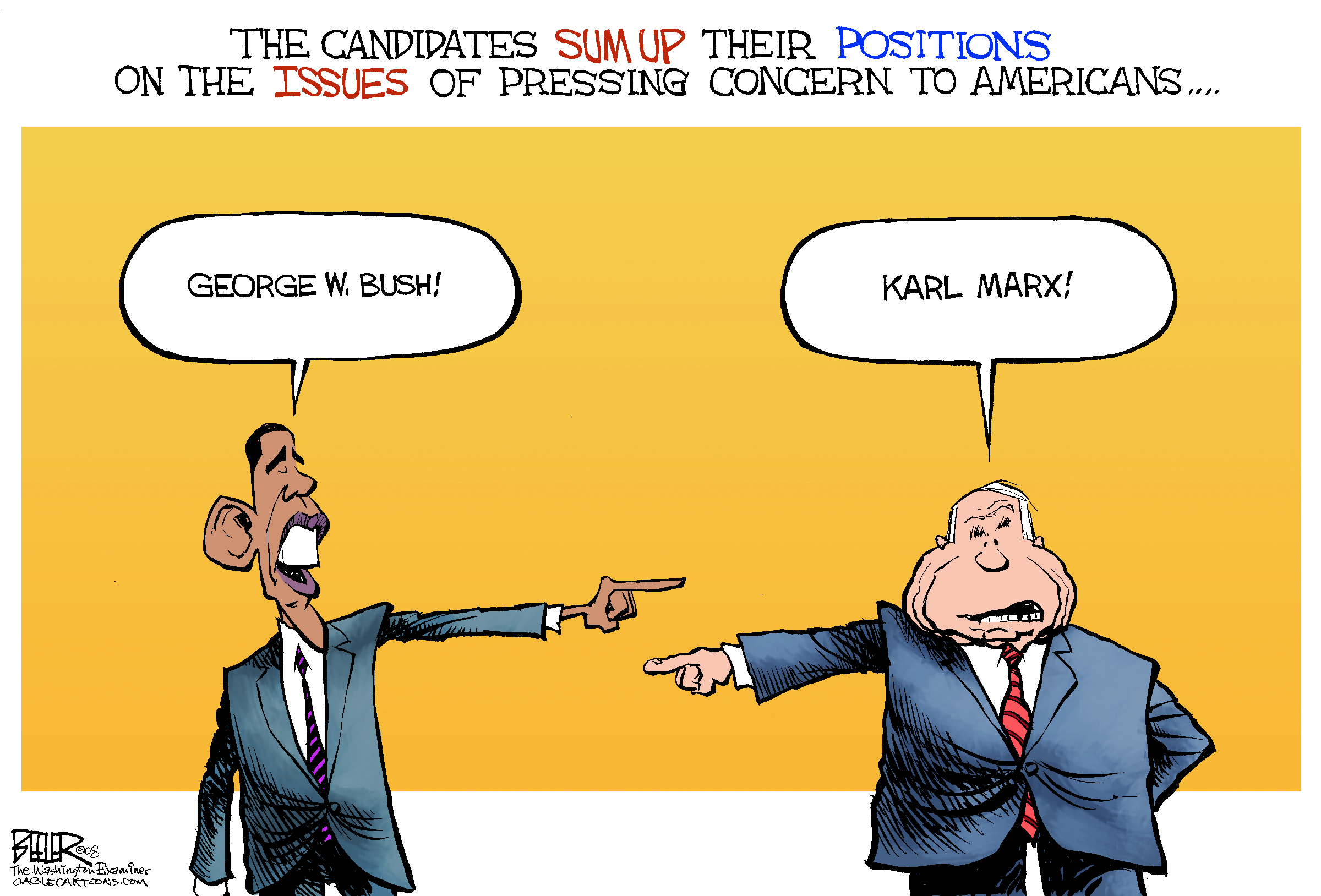
Images
1. youngpatriots.com 2012
2. The Washington Examiner 2008

This is a very interesting post. I think there definitely are some similarities between the two. Obama is very concerned about helping the poor, and bringing down the wealthy. This is similar to communism. Youre point on the media is also interesting. It is amazing how the media can twist things to make it seem like what they want you to believe.
ReplyDeleteThis is an interesting post, but one steeped in the anti-Marxism taught by the America that feared Communism so much that it fought wars that had no actual connection to communism (i.e. Vietnam). As Professor LM pointed out in lecture, Marxism is more than the stereotypical view of socialism/communism so often thrown around on television, on the radio and in public forum by politicians, pundits and citizens alike.
ReplyDeleteCertainly, America features many Marxist-similar policies, namely the graduated income tax (redistribution of wealth). Of course, MANY industrialized nations use a progressive tax, even the United Kingdom, birthplace of the free economy, where William Pitt introduced a graduated tax to pay for the Napoleonic Wars two decades before Marx was even born. Indeed, income tax rates on the wealthy (defined however one wishes) are incredibly low compared to peaks earlier in the 20th century. That is to say, Obama is by no means Marxist revolutionary to suggest that the law of the land should require higher tax rates for those who make lots of money.
Your argument concerning Obama's lack of support for outsourcing doesn't really make sense, for keeping businesses operating within our borders has no correlation with state control of businesses, at least how Marx considers it. (That is, Marx says that nations must control the MEANS of production, of capital).
Lastly, the Troubled Asset Relief Program (TARP) was a program passed under George W Bush before the 2008 election (as banking stocks were in full crisis-mode), not by Obama. The economics are complicated, but the reason all the banks were forced to take the money had legitimate reasons. Namely, if banks had the option to NOT take money, it would signal significant weaknesses in the banks that DID. The entire operation's goal was to create stability within the banking system- to avoid a run on the banks, 1929 Black Tuesday style. Indeed, the contrary option to TARP was incredibly more Marxist- a nationalization of the banks, wherein the federal government would have taken over the banking system, a debate that was not unheard of in the fall of 2008.
Basically, while we could debate the merits concerning the fear of Marxism in America, Obama is not as radical as many seem to think he is. Just my two cents.
I agree with Jeff, sure America contains some Marxist-similar policies, but some of them are pre-Marx, and very common in capitalist economies. But I think the real problems here is as Jeff said, the views of anti-Marxism created by a Cold War America steeped in a fear of communism. As Prof LM said, Marxism isn't just the stereotypical communism it has been depicted as in recent years.
ReplyDeleteSure Obama may have some socialist values, but there is nothing wrong with that. May I remind you that one of the strongest global economies, Germany, is very socialist when compared to other economies in the region. Take for example Obama being against companies moving jobs and manufacturing over seas. This is in fact the same policy Germany has, where a certain percentage of manufacturing must be done in the country. The reason for this is because you create jobs in the US, reducing unemployment. And when you have more individuals employed, other parts of the economy can grow and are strengthened. Now I'm not going to go very much into this, as it requires an understanding of macro-economics, but I'm sure you get the idea.
I agree that there are similarities in ideals between Karl Marx and President Obama. But then, this would be true of much of the political left, not just of Obama. Also, simply because the two share similar ideologies does not mean that Obama will turn the United States into a Communist powerhouse. As history has shown, the idea of true communism is much different from what has actually been put into practice. One could say that true communism is an impossible thing to achieve on a large scale, simply because it is too hard to enforce. Thus the autocratic governments rise along with "communist" regimes and, in the end, stray far from true communism. As someone who usually identifies with the moderate right, by no means the far right, I can see your point in a lot of these similarities. However, I do think that it is dangerous to call Obama a marxist or socialist simply because he shares some very basic ideologies with a long dead German writer. He has proven over the past four years that he is not a true marxist. This sort of thinking is harmful across the entire of spectrum of American politics, much like when the left calls the right "fascist," "racist," or "insensitive to the poor." These things would certainly apply to some of the modern right, but not to all or even most of it. Much like not all leftists are marxist or socialist. But even still, a very stimulating post!
ReplyDeleteI agree with Justin. Though both Communists and Democrats fall on the left side of the political spectrum, I think it's a little bit too far to say Obama and Marx are one in the same. It's easy to find illusory correlations between anything if you look hard enough to find them. In a checks and balances government like ours, there is no way the president, whether it's Obama or anyone else, would take our country on the Communist path you seem to think its headed down. Yes, Obama is a supporter of distributing wealth, it's to an extent that is by no means on the levels that Marx advocates. While I may not agree with you, I admire you having the courage to so boldly put your political views out there.
ReplyDelete